

UTAH: 5 BEST VIEWS (that don't require a permit!)
- thekatidaulton
- May 18, 2025
- 6 min read
Updated: Jul 20, 2025
There are countless views within Utah and the upper limits of Arizona, that will knock the breath out of you. But many require a permit to be purchased days, if not months ahead of time.
However, if you're like me, sometimes the trip might be booked when flights are cheap (and often that is just a couple of weeks before you are at the destination).
So here is a short list of beautiful locations that are all unique in their own right and don't require a permit.
Though-disclaimer-some of these require do require the daily national park payment (but you don't have to pay ahead of time-unless it's Arches National Park, in which case there is a timed entry reservation but not a permit).
These aren't in particular order, just the order we saw them!
ZION - Watchmen Trail (Early morning or Late afternoon)

Nearly every rock face in Zion National Park has a unique gradient, with their iconic, red hue contrasted perfectly by green foliage.
Simply driving through the winding roads of the national park can be enough to see the steep walls aglow with early morning or late afternoon light (the best times to see all the details of the sheer, rock faces).
But specifically, the Watchman Trail, a 1.4 mi in and out trail, gives you one of the best views of that pointed rock that Zion is known for.
The trail itself was rather steep; there is a little under a 500 ft elevation gain (which for a Midwesterner is a lot), but it's completely doable and worth the view at the end.
It took us a little over an hour to make it up to the lookout point and I suggest you don't do it when the sun is beating down at 2-3pm like we did. But the early morning light or more towards sunset, offer the best shadows.
Bryce - Navajo Loop (Sunset)
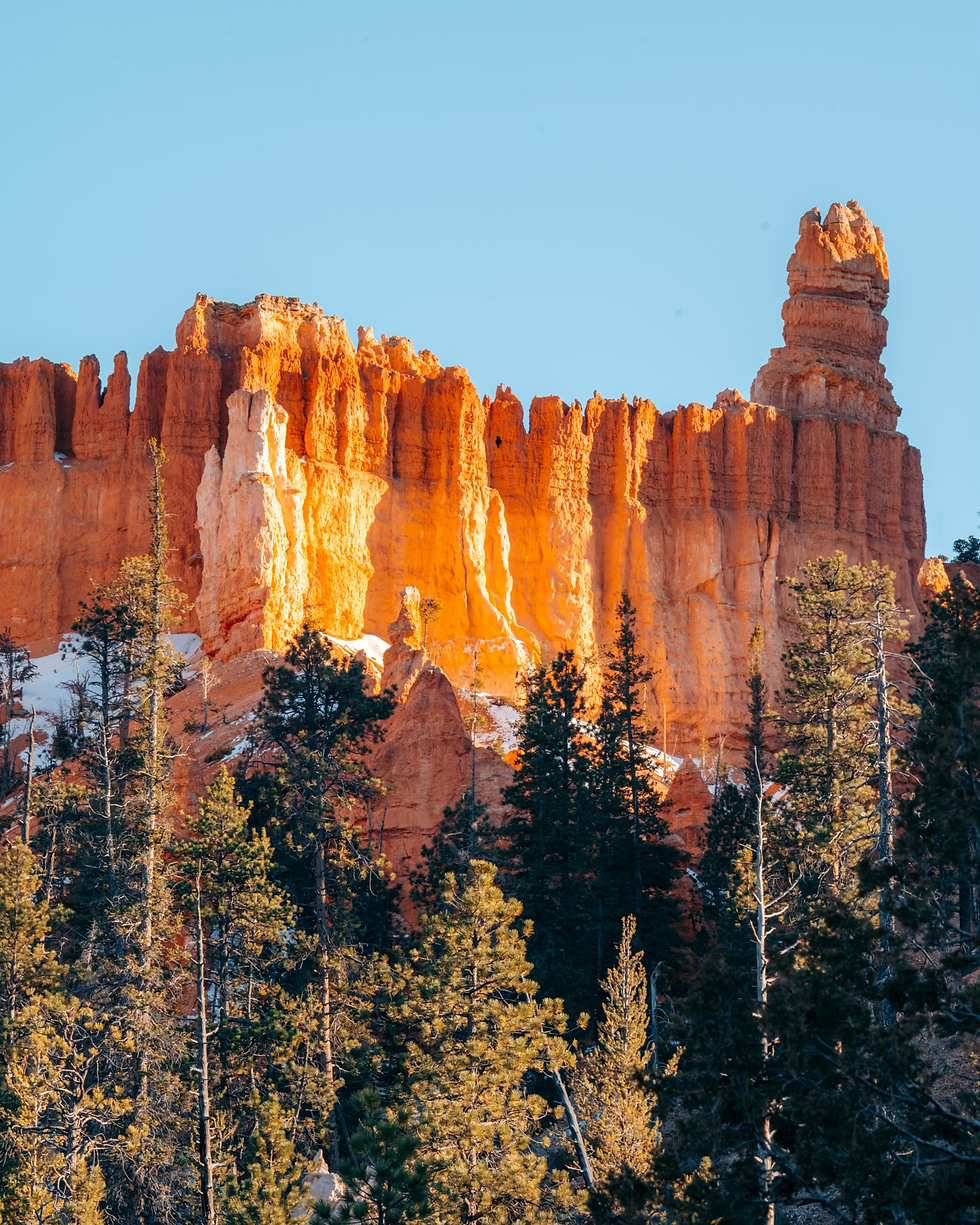
There are so many beautiful hoodoos, the fun name for the spire-like formations that Bryce National Park is famous for.
Where Zion is red and green, Bryce is a tangerine marmalade orange. The vibrant color comes from the iron oxide in the sedimentary rock.
There are a variety of cleverly named hoodoos through the park and especially along the Navajo Loop, a famous hiking path that takes you through the hoodoos and back to the lookout point.
When we went, half of the loop was closed, but we still got to see some of the famous hoodoos and make up names for the different formations as there are tons of statue-like spires that rouse the imagination.
The best time, though, to catch the orange color at its most vibrant stage is right before sunset.
There are two lookout points (namely sunset and sunrise, I'm sure you can guess which you should go to at which time of the day), but for the brilliant rays of the setting sun were for lighting the hoodoos ablaze.
Canyonlands - Green River Overlook (Sunset)

Of all the places we went, Canyonlands National Park was likely the most impactful because of how vast it was. This overlook is not a hike, so if you are looking to rest your weary bones consider this small jaunt that can be made mostly by car.
The lookout point over Green River is incredible. You can see miles away and (if you have good sight) you can even see the 'Desert Varnish', black streaks down the sides of the meandering canyon walls.
We explored a little past the designated lookout point to a further overlook that was quieter. There are large boulders to take photos on or picnic upon if you wanted to take some snacks out and watch the sun set.
It's best to take photos of this magnificent view during what is called the "Blue Hour". Similar to what "Golden Hour" is to city and coastal photographers as "Blue hour" is for those photographing desert environments. The 20 to 90 minutes before sunrise and after sunset are considered blue hour. During this small window the blues and purples of the desert stones pop, bringing out the variegated tones.
We'll see a more pronounced example of this with the Bentonite hills.
Bentonite Hills - (Sunset)

There were quite a few even more contrasting images that exemplify the blues and purple of the clay hills, found near Capitol Reef National Park. On this list, this in the only place that is neither a National Park nor requires a timed entry (as some landmarks do).
Right off of Highway 24 are these out-of-this-world mounds, spanning 3 miles of rugged terrain. You will definitely need a 4x4 vehicle (we rented one for the day to go 'off-roading'). As you exit Highway 24 and turn onto a dirt road, you will find yourself transported from Utah to Mars.
In fact, there is a small Mars Training station in the Bentonite hills, and you will pass it as you head towards the colorful mounds. The environment of the Bentonite hills closely resembles the environment of our neighbor planet: Mars and is therefore used as testing and training grounds for NASA.
If you come right at Sunset, you will see the hills slowly change of a rusty red (like in the picture above) to a variety of purples, reds, and blues (as pictured below).

This was such a special experience. Not only because I have never been to a place with this unique of terrain that made me feel like I was wondering a lonely planet, nor because it reminds me of a topographical map, but because it beautifully showcases how diverse Utah's range can be. Just in a two hour drive the sand outside the windows can change and form into extraterrestrial terrain.
This place is completely free, aside from bringing a sturdy vehicle to explore it. Be careful of the cows and treat the land like the precious resource it is.
Arches - Sand Dune and Double Arches (Ideally Early Morning)

Of the items on this list, this one is the exception. NO, it doesn't require a PERMIT, but due to the amount of tourist traffic, it does require a timed entry payment of $2 per car. This means you have to purchase a timed entry online and you can enter the park at that time and stay the rest of the day.
It doesn't require months of preparation, nor a submitted plan like some of the other popular hikes in Utah's national parks.
Arches National Park is the second most popular national park in Utah and it's also on the most visited national parks, following closely behind Zion.
But there is a reason for its popularity. It's home to some of the most unique, natural rock formations in the United States. It's most famous being the Delicate Arch.
But that isn't the only arch there. In fact, as you drive through the park, you'll probably spot more than a dozen arches in the rock walls. The current count is a little over 2000 arches! Each shaped in its own fun and weird way.
However, the most picturesque, in my opinion are the Sand Dune and Double Arch. I would say they are almost as trafficked as Delicate Arch, too.
So, to get good photos it is best to go early in the morning! As most park goers work their way around the park through the afternoon to sunset. The narrow walking paths can get quite crowded and clogged with people taking photos and admiring the archways.
Be mindful of other park goers as we are all here to see the unique nature not just watch a sand photoshoot!
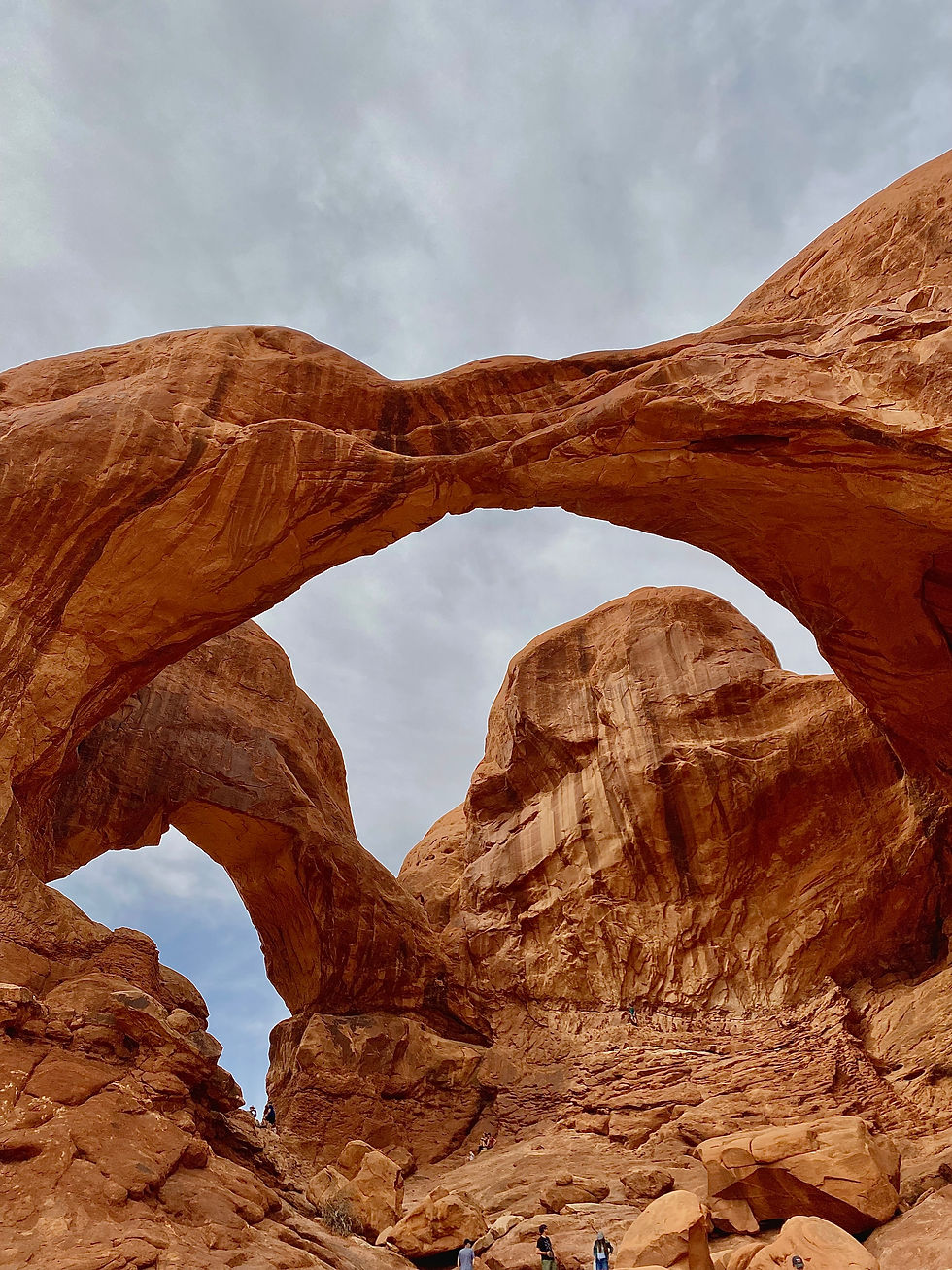
As I said prior, it is best to see the arches in the early morning, but we were not able to get to the Double Arch in time. However, it was still magnificent to see! This arch was even larger than I had expected! It stands a little over 10 stories high (112 feet) and has lots of climbing opportunities!
The Double Arch can be found near the Window Arches and has ample photo spots. Whether you are looking to frame your photo with a round arch or just capture the sheer height of the two, together, it is an impressive view!
There you have it!
5 of Utah's Best Views that don't require a permit!
I suggest you buy an "America the Beautiful" national park pass to cut down on the park entry fees, as each National Park Entry fees can cost upwards of $30 dollars per person. But with an annual pass that costs $80, you can cut the costs in half and continue to use the pass for other national parks.
Ultimately this was such a beautiful road trip that offered a diverse collection of breath-taking views. All these spots can be accessed following Highway 24! It's the perfect set up for a road trip, whether you are camping out or doing day trips to national parks.
We did this trip in 4 days but if you want to do more hikes and explore slower it can easily be expanded into a 2 weeklong trip, spending your afternoons trekking and your mornings and evenings setting up at these gorgeous locations.


Comments